Deciding on what camera to use when you are a beginner is often really difficult. There are nearly an infinite amount of options. To help you in making the right choice, below are some invaluable tips. These tips include the best cameras available in the market for beginners in 2024. There is also extra information about their specifications.
JOYSONG Cube Rower: Versatile Home Fitness Solution
Key Factors to Consider When Buying a Camera for Beginners in 2024
Personally, it is always not easy to select the right camera that is suitable for a beginner. Here are some essential factors to consider:
1. Type of Camera:
- DSLR (Digital Single-Lens Reflex): It gives the most control. It can be used in a large range of applications. But, they are often more cumbersome and costly.
- Mirrorless Camera: Known to be more portable than DSLRs. They are available in a smaller and lighter size with similar or the same quality of picture.
- Point-and-Shoot Camera: It is easy to use but lacks a lot of operational controls in its handling.
- Smartphone Camera: This method is mostly used in casual shooting. It comes with some poor quality and flexibility of the images.
2. Sensor Size:
- By comparison, larger sensors offer better image quality. This is particularly true when it comes to conditions that are ‘low light’. Among the types of sensors, full-frame is the largest, and the size is followed by APS-C and Micro Four Thirds.
3. Lens:
- Kit Lens: Slightly cheaper than cameras, it is a universal lens that can used for any type of subjects.
- Prime Lens: It has a non-variable focus which results to better image quality and at times faster aperture.
- Zoom Lens: It affords you a closer look at your subject. But, it gives slightly poor image quality in comparison with optical.
4. Autofocus:
- Phase Detection Autofocus: Better and quicker for every passing object to be tracked.
- Contrast Detection Autofocus: While not as fast it can be used in conditions with low light.
5. Image Quality:
- Megapixels: You get more details in your images with more megapixels; though it is not the only parameter.
- Dynamic Range: The capacity to record details of the light part as well as the dark part of a scene.
- ISO Sensitivity: On the flow the camera performs in low light environments.
6. Video Capabilities:
- 4K Video: Provides more detailed information to the user.
- Frame Rate: There are times when a higher frame rate is preferred like when recording action (like 60 fps).
- Stabilization: It assists in minimizing the amount of shake in videos.
7. Ergonomics:
- Comfort: Make sure that the camera is well held on the palm of your hand.
- Controls: In the design features of the controls, attention must be paid to the arrangement of buttons. Dials should also be arranged carefully.
- Budget:
- Establish reasonable price range and study the cameras which have been categorized under the price range.
Additional Tips:
- Consider your interests: It also be wise to consider what sort of photography appeals to you the most. For example, portrait photography, landscape photography, sports photography, etc.
- Read reviews: To choose the correct model, put some time into studying the different camera models available. Also, read about other users’ experiences.
- Try before you buy: If it is convenient to do so, go to a photography store to hold the camera.
It thus guides a beginner in choosing the right camera. It ensures the camera matches their budget without compromising on quality.
Selecting a camera is not very easy especially if you are selecting one that will be your first camera. Here are five excellent options to consider:
1. Canon EOS Rebel T8i
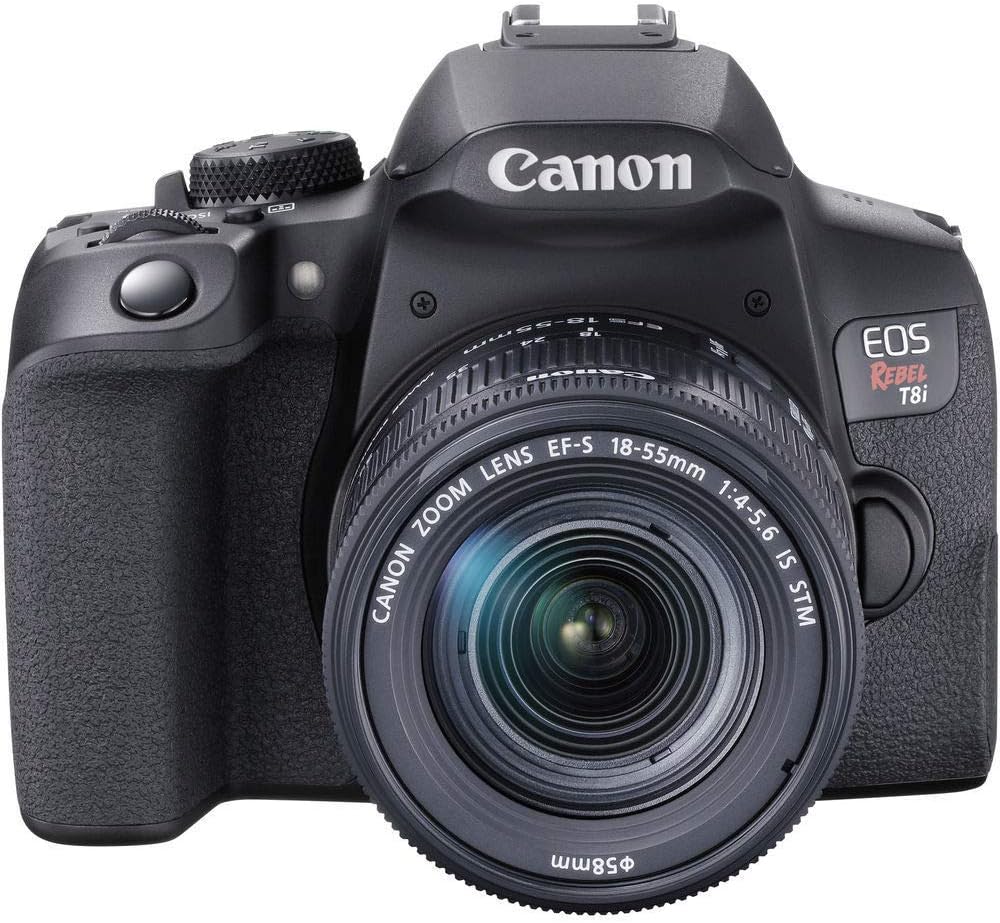
The Canon EOS Rebel T8i or EOS 850D is an advanced DSLR camera. It is suitable for first-time buyers. It also meets the needs of professional photographers. Here are its key features, along with some pros and cons:
Key Features
- 24. 1 Megapixel APS-C CMOS Sensor: It helps in getting high resolution pictures of superior quality with better color depth.
- DIGIC 8 Image Processor: Improves efficiency and quality of pictures produced by camera.
- 45-Point All Cross-Type AF System: It offers precise focusing. It is also fast, like most of the latest flagship models’ cameras.
- 4K UHD Video Recording: Enables the recording of high quality videos, but at a frames rate of 1. 6x crop.
- Vari-Angle Touchscreen LCD: Allows for explosive shots from all forms of direction.
- Dual Pixel CMOS AF: Helps to give fast and precise auto focus. This works in both live view and video mode.
- Wi-Fi and Bluetooth Connectivity: Allows for simple sharing. You can also use an application on an independent device for usual usage.
- Optical Viewfinder with 95% Coverage: Presents a rather classic approach to DSLR shooting.
Here are some of the pros and cons of the Canon EOS Rebel T8i:
Pros:
- Ease of Use: It is very easy to use. So, it is perfect for start up or even home users.
- Good Image Quality: Delivers highly descriptive and colourful images.
- Effective Autofocus: The ability to achieve fast and correct focusing in stills and video mode.
- Vari-Angle Screen: Contributes to shooting’s ability in different positions.
- Compatibility: Compatible with almost all Canon EF and EF-S lenses.
Cons:
- Cropped 4K Video: I discuss the 1. When shooting in 4K mode crop factor of 6x restricts the viewfinder and thus the field of view.
- No Dual Pixel AF in 4K: What’s more, autofocus performance is lower in 4K video mode.
- Bulky Design: More determined and bulky as compared to mirrorless counterparts.
- Limited Focus Area in Viewfinder: Less area of view when using the Hybrid AF when using the optical viewfinder.
In conclusion:
The Canon EOS Rebel T8i is a decent choice. It is ideal for people who want to improve from a mobile phone or an entry-level camera. It is a perfect blend of characteristics and execution.
2. Sony Alpha a6100

The first camera, Sony Alpha a6100, belongs to the mirrorless category of cameras. It is considered rather popular among newcomers and amateurs. Here are its key features, along with some pros and cons:
Key Features:
- 24. 2 Megapixel APS-C CMOS Sensor: Delivers images of great clearness with very much detail.
- BIONZ X Image Processor: Increases the quality of image and its functionality.
- 425-Point Hybrid Autofocus System: Includes the autofocus feature. It works at a very high speed and in real-time. It supports both tracking and eye autofocus.
- 4K UHD Video Recording: Has the ability to capture subjects in 4k resolution video quality.
- 3. 0-inch Tilting Touchscreen LCD: Allows for a simple and non-constrained approach to shooting in all different angles.
- Built-in Wi-Fi and Bluetooth: It enables it to be easily shared as well as to be controlled remotely.
- 11 fps Continuous Shooting: Serves best in case of moving objects / actors.
- Compact and Lightweight Design: Portable in nature thus suitable for carrying around especially when you are on a trip.
Here are some of the pros and cons of the Sony Alpha a6100:
Pros:
- Outstanding Autofocus: This particular autofocus system is called 425-point autofocus system. It works brilliantly, especially when dealing with moving objects.
- Excellent Image Quality: The camera captures bright and clear images and that are even good for night shootings.
- 4K Video Capabilities: Has the functionality of recording videos at a high quality and with good details.
- User-Friendly: The controls of the interface are friendly hence can be regarded as appropriate for beginners.
- Good Battery Life: The battery life is decent enough to give reasonable number of shots for any mirrorless camera.
Cons:
- No In-Body Image Stabilization: It has no stabilization. This is a barrier when it comes to shooting while on the go.
- Relatively Low-Resolution Viewfinder: The electronic viewfinder’s resolution is not as high. It is lower than that in some of the company’s competitors.
- Plastic Build: But, the vehicle’s body has a less luxurious touch, thanks to the use of plastic instead of metals.
- Limited Touchscreen Functionality: The glimpse is mainly for focus point choice. It is amazing. Such a dramatic difference in speed is solely attributable to the touchscreen. This difference is not due to any difference in camera hardware.
- Rolling Shutter in Video: Suffers from rolling shutter effect especially when making fast movements in the viewfinder during video shoot.
In conclusion:
The Sony Alpha a6100 can be recommended for those who are interested in mirrorless photography. This camera demands an acceptable price for good functionality.
3. Fujifilm X-T30 II

The Fujifilm X-T30 II is a compact camera. It is perfect for those who want to take photos. It caters to both enthusiasts and amateur photographers. Here are its key features, along with some pros and cons:Here are its key features, along with some pros and cons:
Key Features:
- 26. 1 Megapixel APS-C X-Trans CMOS 4 Sensor: It offers bright illuminated and clear pictures with correct colour balance.
- X-Processor 4: Improves the overall speed of the device. There is an enhancement in the quality of images that can be produced.
- 425-Point Hybrid Autofocus System: Enables rapid and precise autofocus in subjects’ faces and eyes.
- 4K UHD Video Recording: Has the potential to capture Full HD video. The resolution is 4K at thirty frames per second.
- 3. 0-inch Tilting Touchscreen LCD: The design of the car enables the easy maneuvering of the camera. It also provides for different shooting positions.
- Film Simulation Modes: Provides many options in creative to reproduce styles typical to cinema.
- Compact and Lightweight Design: Lightweight, which means one can easily carry it along during travels among other activities.
- Wi-Fi and Bluetooth Connectivity: Can share am envisage itself and turn into a remote.
Here are some of the pros and cons of the Fujifilm X-T30 II:
Pros:
- Excellent Image Quality: Provides excellent image detail and contrast, and excellent color reproduction.
- Fast Autofocus: The 425-point system is fast and precise even for a moving object or person due to its efficiency.
- User-Friendly Controls: This design features analogue tuners and knobs. These allow the user to control settings without having to take one’s eyes off the screen.
- Good Video Capabilities: As for the video capturing, 4K quality works well. The detail is sharp. The colors are satisfactory.
- Portable: Small size and a small weight making it ideal for travelling or regular use.
Cons:
- No In-Body Image Stabilization (IBIS): Has no stabilization in all the models. This is a big let down when hand holding the camera.
- Limited Battery Life: The battery holding capacity is fairly moderate; general use necessitates spare batteries for extended shooting.
- Small Viewfinder: The electronic viewfinder is not very large compared to some of the counterparts of similar devices.
- Awkward Button Placement: As seen, not all the button placements are as be expected, the Q button for instance.
- Modest Upgrade: Despite of this, the changes are rather minor as compared to the old version.
In conclusion:
The Fujifilm X-T30 II is a versatile camera. Its performance is mixed with good picture quality. It comes in a compact body.
4. Olympus OM-D E-M10 Mark IV

Certainly! Let’s dive into the features and pros/cons of the Olympus OM-D E-M10 Mark IV:
Key Features:
- 20 Megapixel Live MOS Sensor (Four Thirds): This sensor is capable of capturing good image details. It also offers good color accuracy.
- TruePic VIII Processor: Faster operation of the device and improvement of image processing is guaranteed.
- 5-Axis In-Body Image Stabilization (Up to 4. 5 Stops): It assists in maintaining the focus of your shots. This is especially useful during the shooting of images in low lighting areas.
- 121-Point Contrast-Detect AF System: It offers dependable autofocus, but the approach remains based in contrast, just like with earlier models.
- Flip-Down Touchscreen Display: Three-inch, one-piece solid mild steel forging with straight-through or U-shaped cross-sections. It is 04 million dot display. It flips down 180 degrees for selfies. I have to say though that it is not perfect.
- Electronic Viewfinder: Versatile used in compisition with subjects and used instead of LCD screen.
- 4. 5 fps Burst Shooting with AF: Good constant burst mode for the action.
- USB Charging, Wi-Fi, and Bluetooth Connectivity: Some of the other features include USB charging. It also includes Wi-Fi and Bluetooth connectivity. You can share the control of the device. It also includes the convenience of sharing it remotely.
Here are some of the pros and cons of the Olympus OM-D E-M10 Mark IV:
Pros:
- In-Body Stabilization: Perfect for shooting on the go at anytime of the day. It is perfect for night shooting due to its low light ability.
- Compact, Vintage Design: The design of the camera along with the color palette is great. It gives a movie-like feel akin to some of the best film cameras.
- Good Image Quality: Photographing in JPEG format and using extended dynamic range. It delivers smooth 20MP images with nice color rendition.
- Affordable: A rather cheap variant with stabilization and fairly decent capabilities.
Cons:
- Slower Performance: It’s not the quickest process. Still, it is enough to shoot in various scenarios without much of a hitch.
- Limited Raw Image Quality: Lacks a bit when compared with other APS-C competitors in this respect.
In conclusion:
The Olympus OM-D E-M10 Mark IV is an affordable camera with good image quality. It is light and portable. So, it is ideal for travel photography and casual shooting. If there is any question or you need any extra information, please do not hesitate to put it across.
5. Canon PowerShot G7 X Mark III

Certainly! The eyecatching model is the Canon PowerShot G7 X Mark III that is a compact camera with notable functions. Let’s dive into the details:Let’s dive into the details:
- Image Quality: They include; The G7 X Mark III has a new 1. 0-type 20. 1-megapixel stacked CMOS sensor, that gives significantly high image resolution to the device.
- Lens: It has 8 under different categories The format used by this relevant information is 8. 8–36. 8mm f/1. 8-2. 8 zoom lens that can be compared to 24-100mm in the 35mm format. This offers the possibility to shoot in various conditions.
- Video Abilities: It has a 4k video feature which makes the camera ideal for vlogging and general content creation.
- Live Streaming: It has a You tube live stream choice from the camera directly.
- Compact Design: The G7 X Mark III looks and feels like a compact point-and-shoot, with dimensions of 4. 2 x 2. 6 x 1. 6 inches and a weight of 9. 5 ounces.
- Touchscreen: It is easy to use the touchscreen because the buttons are strategically placed. Still, it is a slightly challenging task for people with big fingers.
Here are some of the pros and cons of the Canon PowerShot G7 X Mark III:
Pros:
- Excellent Image Quality: The 1-inch sensor delivers outstanding image quality, even in low-light conditions.
- Versatility: Suitable for a wide range of photography genres, from landscapes to portraits.
- Compact Design: Small and lightweight, making it easy to carry around.
- Touchscreen LCD: Provides intuitive and easy navigation.
- Wi-Fi and Bluetooth Connectivity: Easily share photos and videos with your smartphone.
Cons:
- It does not even come with an eye-level viewfinder. Certain users find this stylish to use. Additionally, it is a bit expensive. Pros:
- Excellent Image Quality: The 1-inch sensor designed for the camera assists in delivering superior images. It works well in any lighting conditions.
- Versatility: Suitable for almost any style of photography ranging from the landscape style to the portrait style.
- Compact Design: Very portable in nature since it is small and lighter as compared to the other analog versions.
- Touchscreen LCD: It also allows users to navigate through the website. The navigation is very natural and effortless.
- Wi-Fi and Bluetooth Connectivity: Transfer images and video messages on this smart phone. Cons:
- Price:It was a point-and-shoot category camera; nevertheless, it was priced higher compared with other models in this category.
- Limited Manual Controls: There’s a dedicated video mode. Nevertheless, it does not have the sort of control and flexibility of your proper DSLR. It also lacks the flexibility of a mirrorless camera.
- Battery Life: Capacity be restricted for those whose need is high. If you are in the market for a high-quality point-and-shoot camera:
In conclusion:
The Canon PowerShot G7 X Mark III. It is highly portable and a very good choice. This is ideal for amateur or average photographers and for those people who are looking for a powerful unit.
Remember: The best camera for you depends on your personal preferences and budget. Consider factors like image quality, features, and ease of use when making your decision.
Watch videos:-
Most views blog:-
Neakasa M1: Open-Top Self-Cleaning Cat Litter Box
ForgedAir: The most comfortable and clearest speaking respirator in the world.
Premium Limited Edition Analogue Pocket: Exquisite Design and Authentic Emulation
Dragon Ridge EDC Knife: Titanium Handle, M390 Blade, Ergonomic Design
LOOI: Turn Your Smartphone into a Desktop Robot!
HERO: Best Carbon-Fiber Electric All-Terrain Bike
15 Amazing New Inventions That Are At Another Level
XbotGo Chameleon Al-Powered Sports Tracking Phone Mount
 Gadgets Hub
Leave a comment