
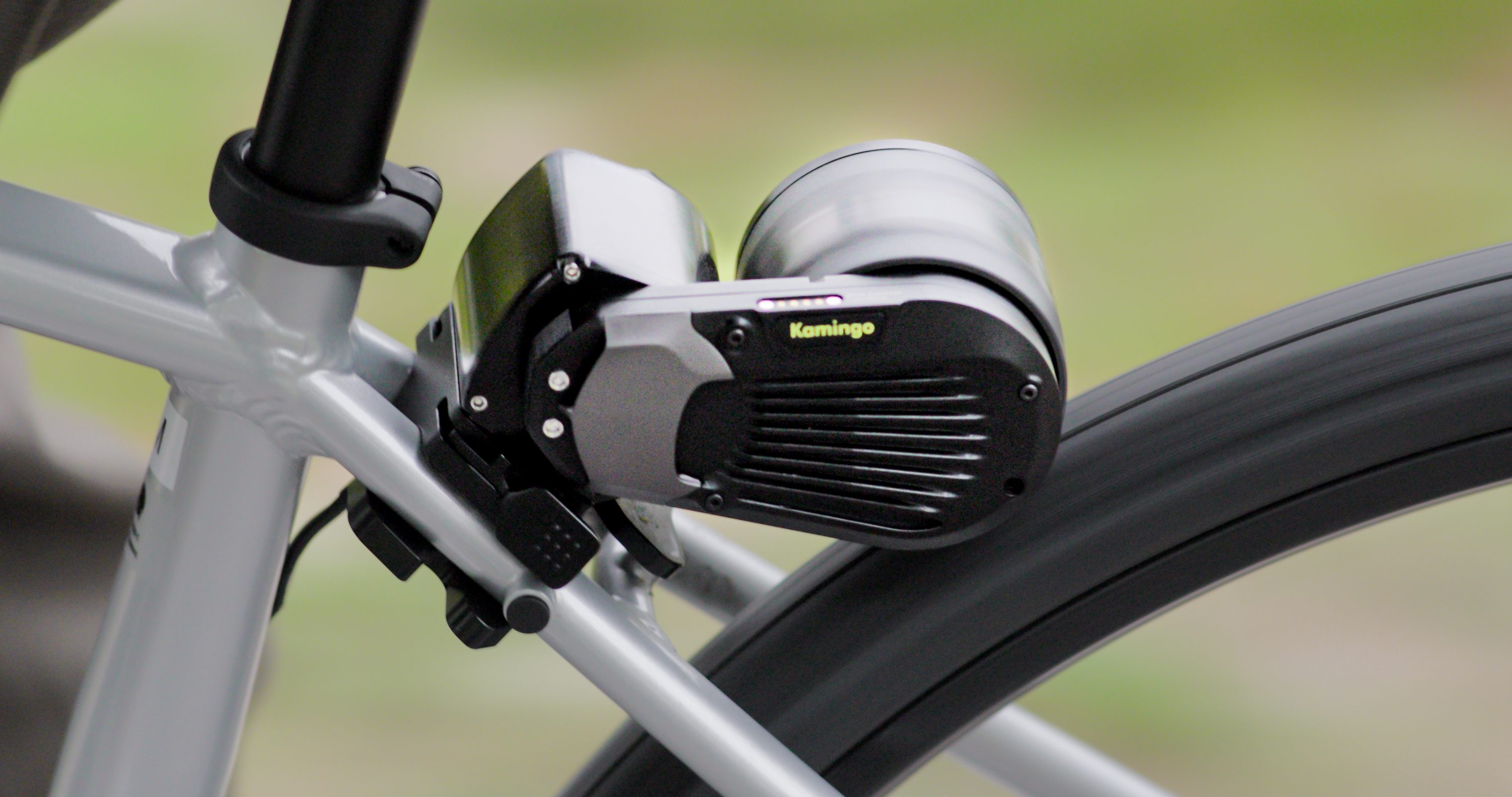

Kamingo is a new e-bike conversion kit. It makes it simple to convert any regular bicycle to an electric one in a few minutes. Portability, ease of installation, and friction-drive motor system are defined as the main features of it.
- These are the major features of the Kamingo:
- These are a few alternatives to the Kamingo, and the important considerations:
- Watch videos:-
These are the major features of the Kamingo:
Core Components & Quick Installation::
Modular 3-Component System: It contains:
- Motor Unit: A small (around 0.9kg) module, which attaches to the bike with the seat stay through a quick-lock base.
- Battery: Designed to resemble a normal bottle water holder (approx. 1.4 kg). Is connected to the motor with the help of a wire.
- Handlebar Mounted Controller: Enables smart command on the fingertip.
- 10-Second” Conversion: The motor, battery, and controller can be connected and disconnected in approximately 10 seconds. It takes 3 minutes for the first setup, with no tools required, to convert between daily applications. This underlines easy conversion.
- Ultra-Portable on its own: The total weight of the device is only 2.3 kg (est. 5lbs), which makes it very easy to carry around and away when not in use.
Power and Performance:
- Peak Power 750W (250W Rated): Provides an extra jump. Bike riders should enjoy obstacles. Going to work with no problem is easy.
- Friction Drive: The motor is in direct contact with the driving of the rear tire by a roller.
- Pressure- Adaptive Technology (PAT): It can automatically control the amount of contact pressure between an assist wheel and tire. It provides good, steady traction over various terrain. It avoids the possibility of sliding. This technology helps prolong the life of tires.
- PMSM Motor and FOC Algorithm: This motor uses a high-performance Permanent Magnet Synchronous Motor. It also applies a Field-Oriented Control algorithm to work efficiently, powerfully, and quietly (56 dB approx).
- Motor Torque: Up to 40 N Situations like smooth, effective acceleration, akin to a full e-bike.
- Top Speeds: 25 km/h (15.5 mph) in Europe (EU), the UK and Australia, or 32 km/h (20 mph) where legal (e.g., USA).
- Regenerative Braking: During braking (and gravity assisted downhill riding), the energy is stored allowing the battery to sustain the range.
Battery & Range:
- 266Wh EV-Grade Battery: Relies on 16 high-density 21700 cells. These are synonymous to the ones used in Tesla cars. This ensures stable power.
- Up to 90 km (55 miles) Range: The range is claimed under Help Mode. But, the real-world figure depends on conditions, terrain, and support level. It will be much lower, say 30-45 km in certain situations.
- Magnetic Fast-Charging: The battery will be charged within 3 hours.
- In-built Power Bank: This has a USB-C output (5v) that can charge phones or any other device on the go.
Ride Modes:
- Standby Mode: The standard cycling practice that does not imply motor support or resistance.
- Assist Mode: Offers pressure-sensitive electric aid which responds according to effort.
- Cruise Mode: provides riding where there is no pedaling (accessibility may vary by local law).
Safety Durability:
- IP66 Rated: Completely waterproof and dust proof in all weather conditions.
- Tilt Detection: The IMU mounted on board stops motor operation if the bike tilts at more than 45 degrees. This safety feature helps avoid accidents.
- Debris Detection: Automatically stops the motor in case of slight obstacles (e.g. rocks or twigs) on the tire.
- Bluetooth-Enabled Quick-Lock: Allow remote locking and securing of the motor by an application in order to prevent theft.
- Drainage Tire Design: To provide more stability when on wet roads.
- Automotive-Grade Battery Cells: To provide even and safe power.
Compatibility:
- Perfect with standard tires or semi-slick ones.
- City, MTB, trekking, folding and some gravel bikes.
- Does not work well with bikes that have mountain tires with deep tread or weird frame shapes.
Kamingo e-bike conversion kit presents an attractive plan of making e-bike conversion as a hassle-free job.
Here are some of the pros and cons of the Kamingo:
Pros:
- Ultra-Fast Conversion (10 Secon): Kamingo created a snap-on/ snap-off design. It is revolutionary for users interested in the freedom to set up their bikes. They can switch to a traditional bike or an e-bike. The set up time also takes a very short time of 3 minutes.
- Small and highly Portable: It weighs 2.3 kg (roughly 5 lbs). With the weight of the whole system, it is one of the lightest conversion kits in the market. This would save carrying when taken out in a backpack. At the same time, it maintains the portable characteristics of your original bike.
- Non-Permanent Modification: It does not involve any complicated wiring or rebuilding of the wheel. The bike frame cannot be altered in any way. Your bike will retain its original integrity and beauty.
- Strong Support (750W Peak): It is a small e-bike, but it has 750W peak power. This power functions as a powerful assistant. Hills and long journeys are much easier to cope with.
- Pressure-Adaptive Technology (PAT): Kamingo Pressure-Adaptive Technology (PAT) is a solution to the typical problems of passing friction drive. It automatically changes the pressure of the contact. This change alleviates tire wear and increases traction. This is an imperative breakthrough on friction systems.
- Regenerative Braking: Implementing this system serves as a bonus. It may help the battery, even broadening the range. This is because energy generated by braking is captured when riding downhill.
- Flexible riding modes: This system provides Standby, Assist, and Cruise (throttle-only) modes. It caters to a variety of riding conditions and preferences.
- Smart Safety Features: Tilt sensors, Debris sensors, and Bluetooth locking add safety. They provide security usually lacking in simpler conversion kits.
- Battery Cells: EV-Grade battery cells show a focus on battery quality. Their technology emphasizes battery life. Electric vehicle cells, such as 21700, are used.
- In-Built Power Bank: The battery has a USB-c power output that is convenient in charging other gadgets during transit.
- Associatively Quiet Operation: Available 56 dB noise level is impressive because friction drive can be noisy, sometimes.
- Cheap (Especiallly Early Bird): It is pretty cheap in comparison to purchasing a specialized e-bike at the early bird rate.
Cons:
- Friction Drive Limitations (In Spite of PAT): Wear on tires: PAT can help reduce this issue. However, friction-reliant motors cause more tire wear than hub or mid-drive motors. This is because there is constant rubbing. This could imply shorter tires durability.
- Wet-Condition Performance: The friction drives perform poorly during wet or glutinous conditions. The roller is prone to slip on a wet tire. This problem cuts down the transfer of power. The design of the drainage tire of Kamingo and IP66 rating assist, however, it remains a pitfall of the technology.
- Aesthetics (to some): The motor unit on the seat stay might not suit everyone’s aesthetic taste. Some prefer the look of integrated e-bikes. For others, it is small enough to be an attractive option.
- Limited bike compatibility: It is not suitable with bikes that have deeply treaded mountain bike tyres. It is also unsuitable for bikes with fat or odd frame geometries. This restricts its applicability to universality.
- Battery Range: The theoretical distance of 90 km (55 miles) in assist mode is understated. In reality, the range is smaller with a friction drive. It is even more limited with a low-power battery of 266Wh. According to Kamingo itself in other advertising publications, the range is about 45km.
- Tire Condition Dependency: A major dependency is the performance on the rear tire condition and inflation. A tired or low tire might affect both performance and productivity in a bad way.
- Crowdfunding Risks: Being a product that has been launched through Kickstarter, there are natural risks in manufacturing delay. The final product might not be as good as promised later on. The project may also not be as successful as promised.
- Minor Slippage/Noise: These can cause slight slippage. They may also issue a whirring sound under a heavy load or acceleration. They are touted as quiet and adaptable.
- No Pedal Sensor: By contrast, with a friction drive, Kamingo responds more directly to pressure sensing. It doesn’t use a pedal-assist sensor (PAS). It may also use a thumb throttle. This can change the feel when riding. (Notice: parts of the marketing say: “Electric support that goes with pedaling effort: Pressure-sensitive.”) This statement could suggest some type of PAS through motor pressure.
Overall:
The Kamingo represents a frame drive solution that is convenient and lightweight. It can be installed on a regular bike. It is so fast and advanced that it can be set on any bike in seconds. Its intelligent friction drive is its main peculiarity. It is also a great option for urban commuters. Occasional riders or people who need a non-permanent e-bike will find it beneficial. Users should be aware that friction drives have constraints. These include tire wear and wet weather tolerability. There are also uncertainties of crowdfunding projects.
These are a few alternatives to the Kamingo, and the important considerations:
The key features of the Kamingo include hyper-fast assembly. It takes only 10 seconds once assembled. The device is also lightweight. Additionally, it has a friction drive with intelligent pressure adjustment. In the search of alternatives, you will find plenty of kind of e-bike conversion kits with their own trade-offs.
- Other Friction Drive Kits:
The kits are similar to Kamingo. They have a non-invasive design. They mount under the seatpost or onto the seat stay. They directly power the rear wheel.
- LIVALL PikaBoost 2:
- Pros: They are extremely fast to set up because they mount on the seat post. They are very lightweight. They also offer features like regenerative braking and smart assistance. They are often price competitive.
- Cons: Likewise Kamingo, susceptible to wear on the tires, low performance during rain. May not provide the same maximum output and cutting-edge pressure-adjusting technology as Kamingo.
- Gboost Friction Drive:
- Pros: Well documented to be easy to install. Comes with a variety of battery range and has regenerative braking.
- Cons: Friction drive still, although tires better be expected to wear and there may be slippage in wet road conditions.
- Qiroll QR-E Ebike Kit:
- Pros: Its size and weight are claimed to be very small and light (motor 0.6kg). Provides features of regenerative braking and simple installation.
- Cons: The same limitations to friction drive. The wattage might be lesser than 750W peak of Kamingo.
- Rubbee Direct Drive Motor:
- Pros: Easy to attach add-on motor that attaches to the seatpost. It is adjustable to a variety of wheel and tire sizes. Low-range modular battery system.
- Cons: Limitation of the friction drive. It may be more apparent aesthetic than that of Kamingo.
- Front Hub Motors Kits:
You fit these to your bike to replace your front wheel. The new wheel boasts a motor mounted on the hub.
- Swytch Kit (Swytch MAX+):
- Pros: quite popular because of its small battery pack (usually mounted inside a handlebar), and rather clean appearance. A hub motor kit installation is easy.
- Cons: You have to replace the front wheel. This process is more time-consuming to attach compared to Kamingo, which can be attached in 10 seconds. Is able to make the front of the bike feel heavier. Low power in comparison with mid-drives.
- Cytronex:
- Pros: This device is very well integrated into itself as the battery resembles a water bottle. Gives extremely natural ride feel.
- Cons: This is more costly and even though installation is a tool-less process it is longer than with Kamingo. Lower wattage.
- Bafang Front Hub Motor Kits:
- Pros: Readily obtainable, usually cheaper and are available in numerous wattages (250W to 750W). Not very difficult to configure.
- Cons: Wheels have to be changed and more time consuming wiring/cable routing. Will easily add an apparent weight to the front wheel.
- Mid-Drive Motor Kits:
These motors are installed in the crankset. They are powered by the gears on the bike.
- Bafang Mid-Drive Motor Kits (e.g. BBS02, BBSHD):
- Pros: Powerful. They are really efficient. They offer a natural ride feel because they can utilize the gearing of your bike. Great on up hills.
- Cons: The most complicated to install among others as it involves dismantling of bottom bracket and crankset. Are heavier than friction or front wheel hub kits. Removeable not in a short time.
- CYC Motor (e.g. CYC Photon Gen 2):
- Pros: High-performance mid-drives available, usually more compact than the Bafang and labeled as a smooth ride.
- Cons: Also it needs to be installed complexly and cannot be removed quickly. The increment of price.
- Pendix eDrive:
- Pros: Reputable and ride-worthy torque-sensing pedal assist. Professionally fitted most often by the dealers.
- Cons: (More) expensive, not self-installed. Not easy to remove.
Key Considerations When Choosing Alternatives:
- Installation Time Permanence:
The Kamingo advantage: attachment in 10 seconds can not be beaten.
Friction drives: They tend to be fast and not permanent.
Hub motors: Needs wheel change, more wiring, but is still by a reasonably DIY.
Mid-drives: At least most required installation (usually permanent). - Ride Feel and Performance:
Friction drives: May feel unnatural, slippery when wet and can lead to wear out of tires. PAT developed by Kamingo tries to reduce this.
Hub motors: Suitable in relaxed rides, may experience that the bike is front or Top-heavy or back-heavy.
Mid- drives:They are most natural and powerful rides since they utilize the gears of your bike. - Tire Compatibility:
Kamingo & Friction Drive: Best in slick tires or standard tires.
Hub & Mid-drives: In general more forgiving of tire type. - Weight And Portability:
Kamingo: It is very light and can be easily removed and carried with.
Friction drives: are normally lightweight.
Hub & Mid-drives: makes bicycles heavier, and often requires taking a wrench to the portability of the bicycle. - Cost:
Some of the cheapest are friction driven and basic hub kits. Mid-drives and high-end built-in systems are higher priced. - Weather Resistance:
Essential in the friction drives (such as Kamingo) to determine their efficacy in the rain. Hub and mid-drives are better unconcerned with wet situation in the tire. - Noise Level:
Friction drives may be louder than geared hub or mid-drives. However, Kamingo says it is not so loud. The noise level is at 56 dB.
Your best alternative will depend on what is of primary importance to you. Immediate, temporary conversion and maximum portability are the principal virtues of other friction drives. In such cases, they are your nearest neighbor. Hub or mid-drive kits may be better alternatives to a more experimental installation. They may also require a little more effort. It depends on what is more important to the prospective owner: a more integrated feel, unadulterated power, or all-weather reliability.
Leave a Reply